Strategies for Beginners and All Kids Under 14
If you are a beginner and have never used weights or plyometrics before, I would recommend that you use only enough weight so you can do 15 - 20 reps of each exercise. Do this for the first two weeks and then continue as prescribed in the workout chart below. Doing this will allow you to explore form, technique, and to build a foundation of strength before adding significant weight. Do not do any plyometrics with weights, and do not do any depth jumps. Squats and other exercises should be done fully to build a base of strength for explosive exercises to come.
Explanation of Workout Chart
-
The workout chart reads from left to right, and each horizontal bar represents a day's work.
-
Click on the exercise for a full description and for alternative exercises.
-
If you are still sore from a workout take an extra rest day. Not getting a full recovery will NEGATIVELY affect results.
-
Do not add this workout to a prior workout. Try to avoid intense activity on the off days, as you need to get a full recovery. Listen to your body. If you are feeling slow, sluggish, or your vertical ever goes down, that is a sure sign you are not allowing for a proper recovery. If you see this happening to you, email me, or take an extra day or two off and start where you left off.
-
Each day have a PWS - Post-Workout Snack. Even on days where you just stretch, or do off-day exercises.
-
If you would like to do your own upper body workout on off days you may, but stay away from anything with legs!
-
I recommend testing your vertical at least on day 1 and day 7. The more you test it the better reading you will get on your improvements.
*Once completed, continuously repeat this 14 day chart with increases in weight (if possible) and intensity.
THE EXERCISES MAY TAKE A FEW MINUTES TO LOAD.
Strength and
Explosion Sets (Weight Training Strategy)
To be implemented with all weight training exercises.
Most weightlifting exercises will go by the
strength and explosion set protocol. This type of set
focuses on building and recruiting fast twitch muscle
fiber, increasing fast twitch muscle fiber size and
strength, and increasing explosive reactions of the trained
muscle. A typical strength and explosion set would be as
follows:
Sets 1 - 3 between 1 - 10 reps
Weight is brought down slowly but contraction is
done emulating jumping explosion, which means to contract as quickly as possible.
Sets 4 -5 between 1 - 10 reps
Set 4 is done slowly and deliberately with a much
stronger focus on form. This allows every part of the
muscle to be strengthened by the exercise.
Set 5 is the burnout set. It is best to
do with a partner. During this set we are going to completely
fatigue the muscles so we can strain every last fiber of the
muscle. Do the first 8 reps exactly as set 4 … if
you can do more go to complete failure. As
soon as you are finished take off a little weight off each
side and do 8 more reps or to complete failure as before. As soon as you finish take off more
weight from both sides and go to failure… then have your
spotter help your force out 3-4 more reps, if you have no spotter you can cheat with your arms depending on the exercise.
This last set, or burnout set, forces the muscles to recruit
every last muscle fiber, even smaller supporting fibers, which allows us to activate and
strengthen muscle fibers that before may have been
dormant. Some may think that since we are not exploding, going to failure is counter-productive. While "explosion" (or in more defined terms, recruitment of all muscle fibers while firing at max rate in the shortest amount of time) is the neural pathway we are training, "failure" training is effective, if practiced only once during the last set of the workout for a given exercise. This means that the majority of the workout is spent on explosion with the heaviest weight possible and the most explosive movements possible, and the "failure" training is used to finish up the workout and stimulate a strength growth.
Note: Set 5 is called a pyramid set, and includes 3 "mini-sets."
Note: "Going to failure" means to perform the exercise until you can no longer lift.
IN BETWEEN SETS: In between every other set do 1 set of 2 reps depth jumps. NO MORE! The key here is to train muscle memory for explosion and fast movements, NOT to have a tiring plyometric workout. After the set is finished allow 20 seconds to one minute to recover then do the depth jumps from 6 - 12 inch drop off. Doing the plyos in between sets helps the strength gains to be "activity specific."
Choosing the right
weight
Find out the max you can do for a given exercise. That means the amount of weight that you can only do 1 rep. Make sure you have a spotter or someone to help you with this. Now take that weight and multiply it by .85. This is the weight you will use. We want you to be able to do 3 - 8 explosive reps. Whenever the speed of the lift slows down you need to STOP. This will ensure that we are recruiting all muscle fibers, and firing them at max rate. Don't worry neccessarily about how fast the weight is going, only that it is going as fast as you can with a given weight. It is the recruitment and firing rate of the muscle that is most important. When you are able to do 8 reps or more at max speed it will be time to retest your your 1 rep max and begin using heavier weight.
Trackable Progress: Progress is not measured by how many reps you do, it is measured by how heavy the weight and how quickly it is taken from relaxed position to fully contracted. If you are moving heavier weight at faster speeds then your vertical will necessarily be improving. One way to track this is to use a stop watch and time how quickly you are able to move a given weight from relaxed to fully contracted.
Quickness
Sets (Plyometric Strategy)
Plyometric and now "heavy"
weight exercises are done to increase your quickness.
NEVER pace yourself during this type of exercise. Doing
so defeats the entire purpose of the drill.
TIP: When possible, always use a target to reach for during the plyo exercises, and continually move that target higher and higher. Reaching for a target will give you a constant focus for continual increase. This target could be the rim, or a mark on a wall.
REMEMBER - Whenever the intensty of each rep lessens, STOP and wait until the next set to continue. We are not training slow movements! I know this message is getting annoying but it's very important for every exercise.
PWS - Protein
Workout Snack
We spoke before how important it is that you
give your muscles the right fuel to build new muscle. Chapter 9 describes your post-workout snack in detail for you.
1. Off Day
Exercises
Every day you should
thoroughly stretch your muscles. Sometime during the day,
perform these few exercises unless you feel
too sore to perform them.
NOTE:
Please note that this should not be tiring or extremely fatiguing and it is only to train your nervous system. Overdoing the off-day exercises will interfere with building and recovering your muscles.
Stretching: On all off days you
should completely stretch your entire body. (See Chapter 7)
Warm-Up:
Before performing off-day exercises you should do a
brief warm-up.
Climax Jumps:
2 Sets of 6 Jumps
Choose a spot in the gym or near
your home that you cannot yet reach with your vertical.
Standing (with no approach) explode up as hard as you can and
try to reach the spot. Land, compose briefly (this is not a plyometric), and repeat
for up to 6 reps. NO MORE.
Heel to toe mini explosions: Take a drop step as if you were going to explode and.as soon as BOTH heels hit, allow your calf muscles to explode, leaving you standing on your toes. Do not jump, but try to explode calf muscle at maximum force. Drop step with your other leg and explode in the same manner - this creates two reps. Do 3 sets of 6 reps. NO MORE.
Sit Down
Reaction Training: 3 Sets of 6
Stand in front of a
chair. Sit down slowly until you feel the chair
underneath you. AS SOON as you feel the chair explode
up to standing position. Repeat for up to 6
repetitions. NO MORE.
2. Explosion
Squats: 5 Sets as
follows
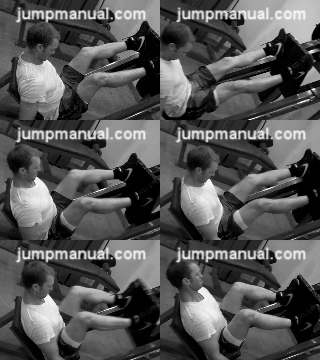 For this exercise you may use a
squat rack (make sure you have a spotter) or you may use a
squat machine or leg press machine. I recommend using a leg
press machine which is better on your back. A true squat will work your back more but
we will isolate your back in other exercises.
For this exercise you may use a
squat rack (make sure you have a spotter) or you may use a
squat machine or leg press machine. I recommend using a leg
press machine which is better on your back. A true squat will work your back more but
we will isolate your back in other exercises.
Load enough weight so that you
can do no more than 8 reps. WARNING: This is very heavy. If you have not squatted before I highly
recommend doing 15 reps for your first workout to avoid
injury. If you do not know how much weight
you need, err on the light side for a warm-up set and judge how
much weight you need to add. Keep your feet
as high up as possible and away from your body. Allow the weight to rest mostly on your
heels. Smoothly and slowly lower the weight
(you should never feel that the weight is falling; it should
always be under control). When your knees
reach your chest EXPLODE back to a starting position with the
intensity of a jump. Repeat this 7 more
times. If you are able to do more than 8
you need to adjust the weight: DO NOT DO MORE REPS. Make the necessary adjustments, but do not do extra
reps. Give yourself two minutes or more to
completely recover so you can do it with just as much
intensity. Stretch your muscles during the
interim.
Repeat for another set.
On the third set add more weight than
normal and ask a spotter to help you. If
you are using a leg press machine you can push your own legs
to spot yourself. Repeat this exercise with
the heavier weight and the same
intensity.
On your fourth set lower
the weight considerably and do 8 slow and steady reps. Do not allow the weight to either fall or
get thrown up as before. Feel the weight
pushing down during the entire contraction.
The fifth set you will want a partner, or to move
very quickly. During this set we are going
to completely fatigue the muscles so we can strain every last
fiber of the muscle. Do the first 8 reps as you did the 4th set … if you can do more go to complete failure. As soon as you are finished take off a
little weight off each side and do 8 more reps or to complete failure as before. As soon as you finish
take off more weight from both sides and go to failure, then
have your spotter help you force out 3-4 more
reps.
Your
legs should be completely toasted after this
workout. Remember the muscle burn you feel
during this will be different from the HIGH repetition
exercises that are less effective for training explosion. It may feel counter-intuitive… and it
is.
Non-Weight Alternative: It is best to find some type of weight to substitute. You can do this with a backpack full of heavy items, a basketball full of pennies, a large rock, or having someone on your back. Don't give up just because a solution doesn't walk up and say hello to you. If you absolutely cannot find any alternative for weights, do this with no weights, but increase your intensity and double your reps.
REMEMBER - Whenever the intensty of each rep lessens, STOP and wait until the next set to continue. We are not training slow movements! I know this message is getting annoying but it's very important for every exercise.
3. Explosion Calf
Raises: 5 Sets as
follows
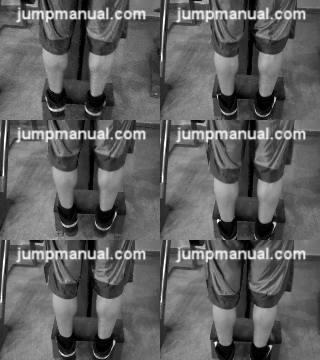 Find a sit down calf machine or other calf
training machine of your choice.
Find a sit down calf machine or other calf
training machine of your choice.
Load enough weight so that you
can do no more than 8 reps.
WARNING: This is very heavy.
If you have not squatted before I highly
recommend doing 15 reps for your first workout to avoid
injury. If you do not know how much weight
you need err on the light side for a warm-up set and judge how
much weight you need to add. Allow the
weight to rest mostly on the front part of your
foot. Smoothly and slowly lower the weight
(you should never feel that the weight is falling; it should
always be under control). When your heels
are as far down as they can go EXPLODE back to a starting
position with the intensity of a jump.Repeat this 7 more times. If you are
able to do more than 8 you need to adjust the weight: DO NOT DO
MORE REPS. Make the necessary adjustments, but do not do extra reps. Give yourself two
minutes or more to completely recover so you can do it with
just as much intensity. Stretch your muscles
during the interim.
Repeat for sets 2 and 3 adding or removing weight as necessary to complete 8 reps: no more or less.
On your fourth set lower
the weight considerably and do 8 slow and steady reps.
Do not allow the weight to either fall or
get thrown up as before. Feel the weight
pushing down during the entire contraction.
The fifth set you will want a partner, or to move
very quickly. During this set we are going
to completely fatigue the muscles so we can strain every last
fiber of the muscle. Do the first 8 reps as you did the 4th set … if you can do more go to complete failure. As soon as you are finished take off a
little weight off each side and do 8 more set or to complete
failure as before. As soon as you finish
take off more weight from both sides and go to failure… then
have your spotter help your force out 3-4 more reps.
By now you should feel unstable
walking because your legs are so exhausted.
Remember the muscle burn you feel during this will be
different from the HIGH repetition exercises that are less
effective for training explosion. It may
feel counter-intuitive… and it is.
Non-Weight Alternative: It is best to find some type of weight to substitute. You can do this with a back back full of heavy items, a basketball full of pennies, a large rock, or having someone on your back. Don't give up just because a solution doesn't walk up and say hello to you. If you absolutely cannot find any alternative for weights, use one leg at a time, but increase your intensity and double your reps.
TIP: At fully contracted position try and be on the tip of your toes and get your toes involved in the workout. YOu may find this hard or even impossible, but continue to try.
4. Dead Lifts: 5 Sets as
follows
 This is an advanced exercise and can also be
substituted for a lower back machine. Please wear a belt
during this exercise.
This is an advanced exercise and can also be
substituted for a lower back machine. Please wear a belt
during this exercise.
Dead Lifts will target the strength of your
lower back and erector muscles. These muscles are used
to propel your body upward and create momentum. To
perform a dead lift use a straight bar (or two
dumbbells). I prefer to use a "smith machine" which has the bar
attached to cords or bars.
Arch your back well and allow your knees to bend
slightly as you grasp the bar. Use substantial weight;
however, if this is your first time you may want to get the
feel of the exercise with lighter weight. Continue
holding the bar as you bring your body to an upright
position. Slowly lower the weight back to the ground and
repeat.
The first 3 sets should be done with 8
reps. The lifting action should be controlled but
quickly. Explosion is desired, but keep the motion
controlled to guard against injury.
On your fourth set decrease the weight considerably and do 8 slow and
steady reps. Do not allow the weight to
either fall or get thrown up as before. Feel the weight pushing down during the
entire contraction.
The fifth set
you will want a partner, or to move very quickly. During this set we are going to completely
fatigue the muscles so we can strain every last fiber of the
muscle. Do the first 8 reps as in set 4 … if
you can do more go to complete failure. As
soon as you are finished take off a little weight off each
side and do 8 more reps or to complete failure as
before. As soon as you finish take off more
weight from both sides and go to failure… then have your
spotter help your force out 3-4 more reps.
Remember the muscle burn you
feel during this will be different from the HIGH repetition
exercises that are less effective for training explosion. It may feel counter-intuitive… and it
is.
Non-Weight Alternative: It is best to find some type of weight to substitute. You can do this with a back back full of heavy items, a basketball full of pennies, a large rock, or having someone on your back. Don't give up just because a solution doesn't walk up and say hello to you. If you absolutely cannot find any alternative for weights, do this with no weights, but increase your intensity and double your reps.
5. Ham Curls
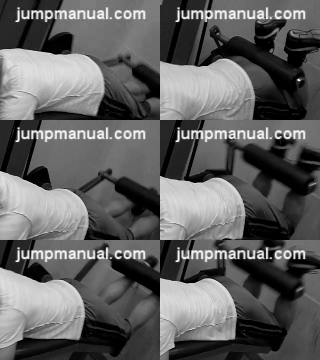 The Ham Curls
Machine is a bench that you lay down and and provides
resistance as you bring your feet towards your rear. Do
this exercise following the 8 rep Strength and Explosion Set
as explained out at the beginning of this chapter.
The Ham Curls
Machine is a bench that you lay down and and provides
resistance as you bring your feet towards your rear. Do
this exercise following the 8 rep Strength and Explosion Set
as explained out at the beginning of this chapter.
Non-Weight Alternative: Laying down as described, have someone provide resistance by holding your feet as you pull them towards your rear thus lifting your upper body. You can also load a bar with weights and place your feet underneath as you lay flat on your belly. Hold weights in your hand to add resistance. Use the same sets and reps as described.
6. Speed
Rope: 3 sets of 30 second
intervals
Speed Rope exercises should be
done at max speed. If you are able to, you should do
doubles or triples (having the rope pass under you 2-3 times
during one jump). However you jump, make it very very
rapid. You may find yourself messing up sometimes.
To increase difficulty try moving around as you jump
rope. Soon people will be mesmerized at how fast you can
jump rope.
7. Rim Jumps: 4 sets
of 6 -10 jumps
Rim jumps can be done with one
or two feet. I recommend doing at least one or two sets
using only one foot. It will feel unbalanced and weak at
first but you will soon notice how much stronger and more
stable each leg feels.
Stand under the rim and put your
hand straight up toward the rim. Jump as high as you can
trying to reach the rim or a point past the rim. AS SOON
AS you touch the ground, explode back into the air and try and
reach that same point. Each jump try and go higher than
the last... Each jump should be at the pinnacle of your
explosion power.
REMEMBER - Whenever the intensty of each rep lessens, STOP and wait until the next set to continue. We are not training slow movements! I know this message is getting annoying but it's very important for every exercise.
8. 1 Leg Chair
Rockets: 4 sets of 6 - 10 jumps
 You will need a sturdy chair or
box for this exercise. Place one foot on the chair and
grab your waist with your hands. Propel yourself straight
upward using the foot that is on the chair and drive the
opposing knee forward as hard as you can. Switch feet
in the air so now the other leg is on the chair and have that
leg thrust you upwards again. Doing both legs counts as
1 rep. Here again, in order for this exercise to be
effective, each jump must be at your maximum
capacity.
You will need a sturdy chair or
box for this exercise. Place one foot on the chair and
grab your waist with your hands. Propel yourself straight
upward using the foot that is on the chair and drive the
opposing knee forward as hard as you can. Switch feet
in the air so now the other leg is on the chair and have that
leg thrust you upwards again. Doing both legs counts as
1 rep. Here again, in order for this exercise to be
effective, each jump must be at your maximum
capacity.
This exercise can be done
holding weights.
REMEMBER - Whenever the intensty of each rep lessens, STOP and wait until the next set to continue. We are not training slow movements! I know this message is getting annoying but it's very important for every exercise.
9. Sprints: 4 sets
Mark off a space of 25-50
yards. Sprint the entire length at FULL speed.
Give yourself plenty of time to rest so that the sprint can be
at maximum capacity. Repeat.
REMEMBER - Whenever the intensty of each rep lessens, STOP and wait until the next set to continue. We are not training slow movements! I know this message is getting annoying but it's very important for every exercise.
10. Medicine Ball
Approaches: 4 sets of 6 - 8 approaches
 Using the heaviest medicine
ball available, approach the rim or the net as if you were
going to dunk or spike. Exaggerating the up and down
movement with the ball in your hands, explode upwards toward
the rim.
Using the heaviest medicine
ball available, approach the rim or the net as if you were
going to dunk or spike. Exaggerating the up and down
movement with the ball in your hands, explode upwards toward
the rim.
Each approach should push your
capacity to its maximum.
REMEMBER - Whenever the intensty of each rep lessens, STOP and wait until the next set to continue. We are not training slow movements! I know this message is getting annoying but it's very important for every exercise.
11. Hang Cleans: 3 sets of
6
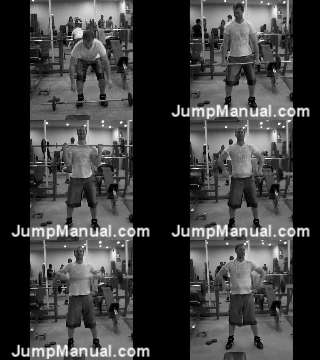 Using a straight bar, hold the
bar slightly wider than shoulder width apart. Jumping
and pulling the weight up at the same time, bring your elbows
underneath the bar and hold the weight up. Let the
weight drop back down to your legs and repeat this.
Using a straight bar, hold the
bar slightly wider than shoulder width apart. Jumping
and pulling the weight up at the same time, bring your elbows
underneath the bar and hold the weight up. Let the
weight drop back down to your legs and repeat this.
If you do not have access to the weights necessary for performing this exercise, replace this with Medicine Ball Throws.
12. Depth Jumps: 4 sets
of 8
 Stand on a box and step off...
AS SOON AS you touch the ground explode up with maximum
force. It is best to do this drill in front of a rim and
try to get as high as possible.
Stand on a box and step off...
AS SOON AS you touch the ground explode up with maximum
force. It is best to do this drill in front of a rim and
try to get as high as possible.
13. Side to Side Box Jumps:
4 sets of 8
Using a box 1 - 2 feet high
jump side to side over the box. Each jump is counted as
one rep.
14. Weighted Explosions:
3 sets of 8
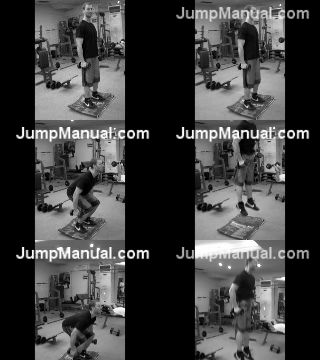 Holding a weight in each hand,
bend down to a squatting position. Pull the weight up
above your head as you explode upwards. Land as softly
as possible. It is best to be on a cushioned surface for
these drills. 15 - 40 dumbbells will usually suffice for
weight.
Holding a weight in each hand,
bend down to a squatting position. Pull the weight up
above your head as you explode upwards. Land as softly
as possible. It is best to be on a cushioned surface for
these drills. 15 - 40 dumbbells will usually suffice for
weight.
Non-Weight Alternative: It is best to find some type of weight to substitute. You can do this with a back back full of heavy items, a basketball full of pennies, a large rock, or having someone on your back. Don't give up just because a solution doesn't walk up and say hello to you. If you absolutely cannot find any alternative for weights, do this with no weights, but increase your intensity and double your reps.
REMEMBER - Whenever the intensty of each rep lessens, STOP and wait until the next set to continue. We are not training slow movements! I know this message is getting annoying but it's very important for every exercise.
15. Medicine Ball Throws:
3 sets of 8
Using the heaviest medicine
ball you have, go into an open area where you can throw the
ball. Outdoors is best. Bring the ball down to the
ground and then throw the ball as high as you can over your
head. Be explosive as possible as you jump into the air
while hurling the ball as high as possible.
Non-Weight Alternative: It is best to find some type of weight to substitute. You can do this with a back back full of heavy items, a basketball full of pennies, a large rock, or having someone on your back. Don't give up just because a solution doesn't walk up and say hello to you. If you absolutely cannot find any alternative for weights, do this with no weights, but increase your intensity and double your reps.
16.
Zig Zags: 3 sets of 10 - 15; 2 sets back and
forth
 Stand on the right side of a
line. Keep your feet pressed together as you go side to
side on the line. Over and back is one repetition.
The key is to go as fast as possible. If you get tired
and find yourself pacing, lower the reps.
Stand on the right side of a
line. Keep your feet pressed together as you go side to
side on the line. Over and back is one repetition.
The key is to go as fast as possible. If you get tired
and find yourself pacing, lower the reps.
Now stand in front of the line
and go back and forth.
17. In Place Lunges: 3 sets of
6
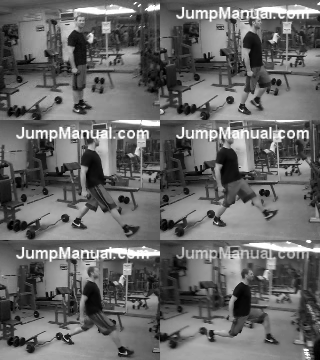 Hold weights to your side or a
weighted barbell over your head. Step forward and pause
for a moment and spring back to the standing position
by pushing off with the same leg you stepped forward
with. A step with each leg is considered one
rep.
Hold weights to your side or a
weighted barbell over your head. Step forward and pause
for a moment and spring back to the standing position
by pushing off with the same leg you stepped forward
with. A step with each leg is considered one
rep.
Non-Weight Alternative: It is best to find some type of weight to substitute. You can do this with a back back full of heavy items, a basketball full of pennies, a large rock, or having someone on your back. Don't give up just because a solution doesn't walk up and say hello to you. If you absolutely cannot find any alternative for weights, do this with no weights, but increase your intensity and double your reps.
17. Knee Drives :This is an excellent exercise to get an additinal boost for your one leg jumping. Do
this exercise following the 8 rep Strength and Explosion Set as explained out at the beginning of this chapter. In place of the normal depth jumps between sets I recommend doing Chair Rockets 1 set of 2 between each set.
Attach a cable to your shoe or ankle. Drive your ankle explosively upwards. If you do not have access to a ankle straps for the Smith Machine you can use ankle weights. If you have no ankle weights do this exercise without any weights. Simply let your foot touch the floor and then snap it up explosively, then repeat.
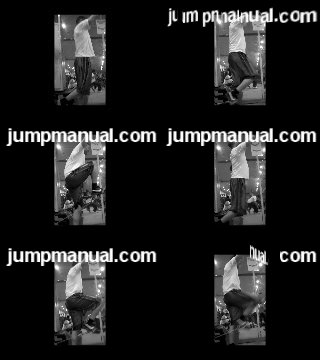
17. Lunge Jumps : 4 sets of 6 - 10 jumps.
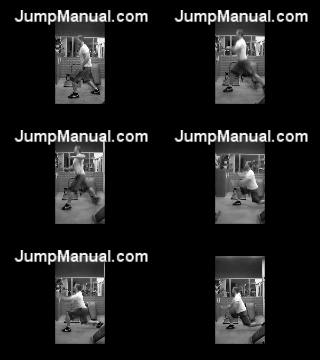
17. Core Series : This is a series of exercises that will give your core more strength and stability, which will allow you to take better advantage of your increased ability to explode.
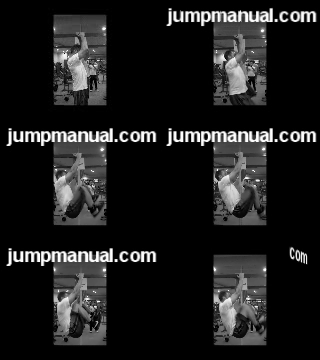
Suspended Leg Lifts - 3 sets of as many explosive reps as possible, then 2 sets slow and steady reps, as many as possible.
During the exercise your legs should only go down to an angle, not completely below your body; this will keep constant tension on your abs. Do not allow a rest period as your legs drop.
Core Static Holds: 4 sets of at least 1 minute per side (front, left, right). 1 set is equivalent to a hold from the front and each side (see below). Start in front, and switch directly to next position after 1 minute is over. If you cannot do 1 minute find your max and subtract 10 seconds. Each week add 15 seconds per side to this exercise.


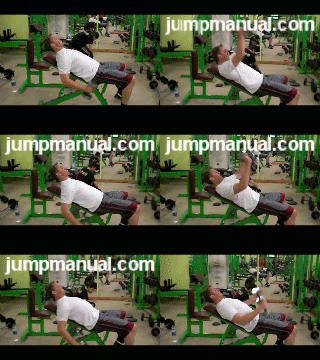
17. Upper Series : The upper body exercises allow you to get your upper body involved in upward momentum and inertia. You are also free to add your own upper body routine; just make sure you add these exercises.
Upward Arm Thrusts: Follow the rules set out in the strength and explosion sets.
REMEMBER - Whenever the intensty of each rep lessens, STOP and wait until the next set to continue. We are not training slow movements! I know this message is getting annoying but it's very important for every exercise.